Carotid-Cavernous Fistula
Overview
Carotid-cavernous fistula, or caroticocavernous fistula, is an acquired communication between the carotid artery system and the cavernous sinus.
Pathophysiology
Relevant Anatomy
-

Contents of the cavernous sinus
-
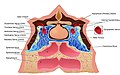
Bilateral cavernous sinus contents with communication through the circular venous plexus
-

Lateral view of the cavernous sinus in the skull base
-

Axial view of the cavernous sinus


Disease Etiology
Classification
Broadly, carotid-cavernous fistulas can be characterized as either direct or indirect. Direct fistulas have a direct communication between the intracavernous ICA itself and the cavernous sinus. Indirect fistulas describe communications from the carotid system to the cavernous sinus through a third vessel, a branch of the ICA or ECA. The most common classification system for carotid-cavernous fistulas is the Barrow classification system, first described in 1985.[1]
| Class | Communication | Description |
|---|---|---|
| A | Direct | Flow from the intracavernous ICA directly into the cavernous sinus |
| B | Indirect | Flow from a branch of the intracavernous ICA into the cavernous sinus via a dural shunt |
| C | Indirect | Flow from a meningeal branch of the ECA into the cavernous sinus via a dural shunt |
| D | Indirect | Multiple dural shunts flowing into the cavernous sinus from the ICA and ECA systems (Class B + C) |
Additional descriptive terms used to classify or categorize carotid-cavernous fistulas are similar to other arteriovenous fistulas, including high flow vs low flow and underlying etiology.
Diagnosis
Patient History
Physical Examination
Laboratory Tests
Imaging
CT angiography or MR angiography are typically the first line imaging modality based on patient presentation and ease of availability in the emergency department. Angiography is the gold standard of diagnostic imaging in order to confirm the communication, as well as describe the location and flow of the fistula.
Differential Diagnosis
Management
Medical Management
Surgical Management
Outcomes
Complications
Prognosis
References
- ↑ Barrow DL, Spector RH, Braun IF, Landman JA, Tindall SC, Tindall GT. Classification and treatment of spontaneous carotid-cavernous sinus fistulas. Journal of neurosurgery. 1985 Feb 1;62(2):248-56. DOI: https://doi.org/10.3171/jns.1985.62.2.0248